An algorithm that designs dental cements to order
Calcium silicate cements usually ship as one-size-fits-all kits. Here, Taguchi screening and genetic algorithms design recipes with properties on demand — and the predicted cements matched reality while staying bioactive.
Fast facts
- —Powder composition, zirconia and water-to-powder ratio varied in a Taguchi array.
- —Five properties tracked: setting time, pH, flowability, strength, radiopacity.
- —Genetic algorithms prescribed recipes; four cements were made and tested.
- —Water-to-powder ratio set strength, flow and setting time; composition set pH.
- —Properties trade off — they cannot all be maximized at once.
- —Designed cements matched their predicted properties; XRD/SEM confirmed the chemistry.
- —Cements tailored to the case, not a one-size-fits-all kit.
- —Bioactive with pulp stem cells — ↑ RUNX2, COL-1, ALP and mineralization.
- —A route to personalized, on-demand precision endodontics.
Fixed kits, but no two cases are the same
Calcium silicate cements are mainstays of endodontics because their chemistry helps preserve and regenerate pulp tissue. Yet they are sold in standardized presentations that ignore what a given clinician or patient actually needs — a faster set for a restless paediatric patient, or higher alkalinity to fight bacteria in a severely infected canal.
The properties that matter — setting time, alkalinity (pH), flowability, mechanical strength and radiopacity — are governed by the powder composition and the water-to-powder ratio. Change one to improve a property and others shift in the wrong direction: more water improves flow but weakens the set cement; more radiopacifier dims mechanical strength.
Because these inputs trade off, tuning one variable at a time cannot find a recipe that satisfies several requirements at once. The search space is simply too large and too entangled.
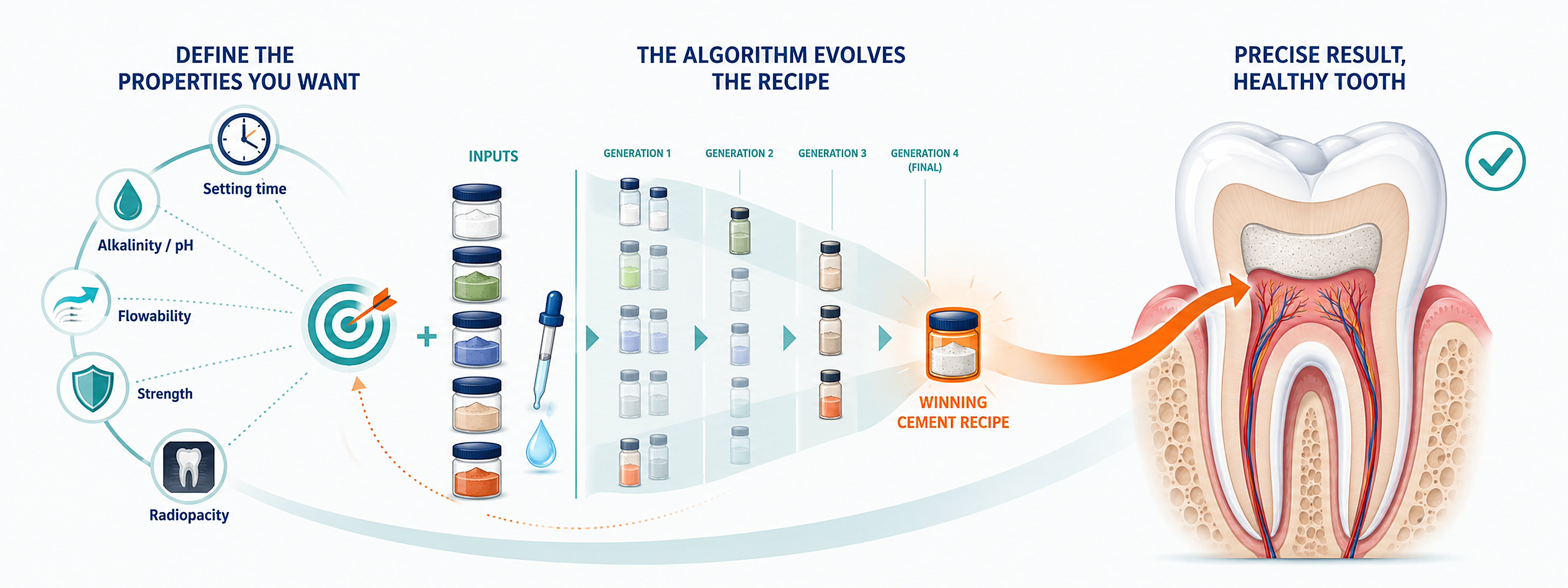
Borrowing evolution to search a huge recipe space
The team first used Taguchi's method — an efficient design-of-experiments approach — to find which ingredients actually move each property, screening the powder composition, the zirconia radiopacifier and the water-to-powder ratio against all five outcomes at once. That narrowed a sprawling problem down to the inputs that genuinely matter.
Those inputs were then handed to a genetic algorithm, an optimizer modelled on natural selection. It generates a whole population of candidate recipes, scores each one against the desired property profile, and lets the fittest combinations carry forward across successive generations while weaker ones are discarded — repeating until the formula converges.
Crucially, the algorithm balances every property at the same time, so it can navigate the trade-offs that defeat one-variable-at-a-time tinkering. Its output is a specific powder-and-water recipe predicted to land on the target profile — which the team then mixed and measured to confirm the prediction held.
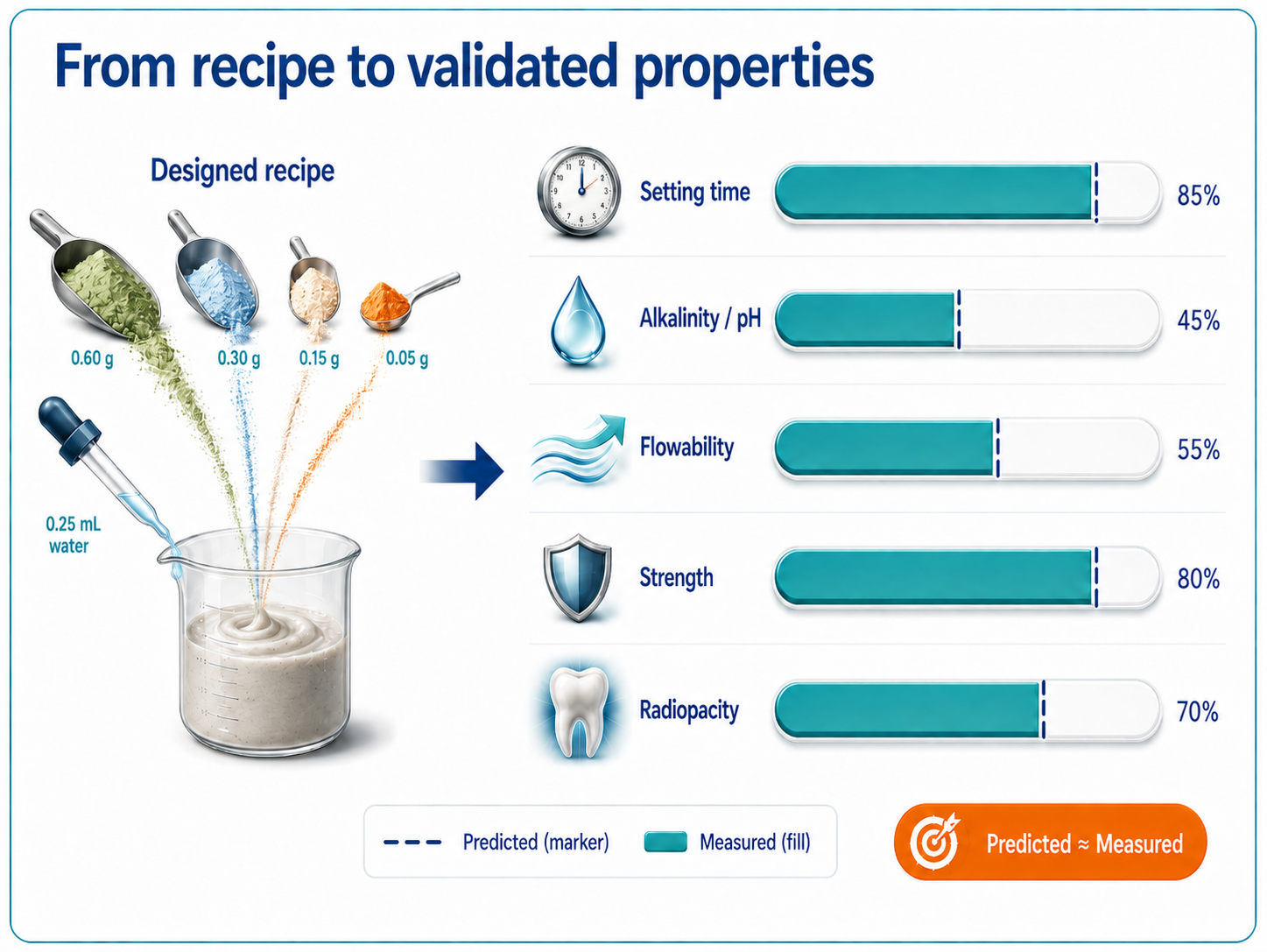
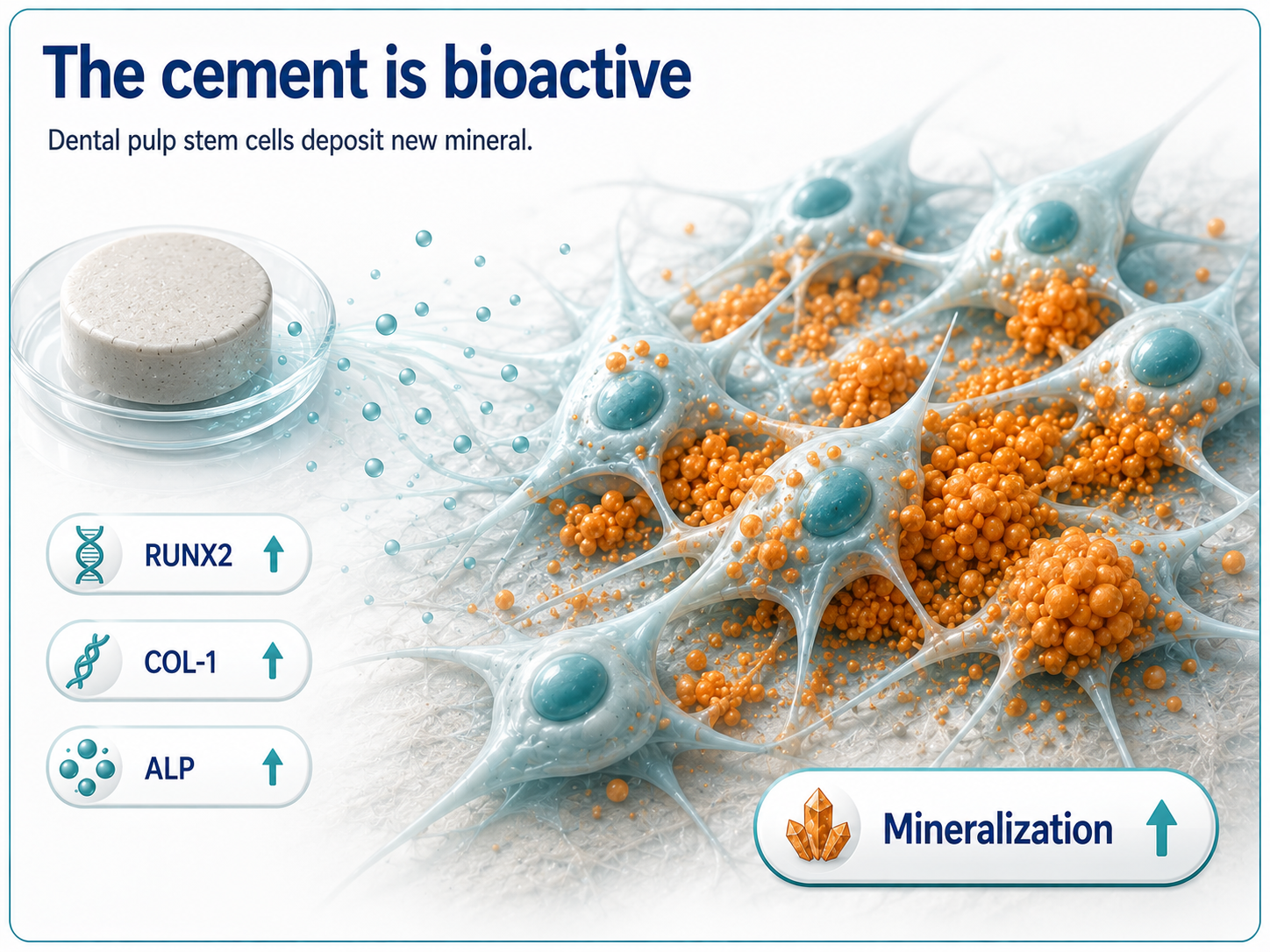
What the algorithm predicted, the cements delivered
Water-to-powder ratio was the strongest lever on setting time, flowability and strength, while powder composition governed pH and added zirconia traded against strength. Mapping these effects exposed clear trade-offs: peak alkalinity, radiopacity and strength could not be reached together with the shortest setting time.
Guided by the genetic algorithm, the team produced four cements with deliberately contrasting profiles. When measured in the laboratory, their setting time, pH, flowability, strength and radiopacity closely matched the predicted values, and X-ray diffraction and electron microscopy confirmed the expected calcium hydroxide and interlocked crystal microstructure.
The cements were also biologically active. Without harming dental pulp stem cells, their extracts increased the expression of RUNX2, COL-1 and ALP, raised ALP activity and boosted mineral deposition — hallmarks of odonto/osteogenic differentiation.
From one-size-fits-all to cement on demand
The advance is not a single number but a way of working. By learning how inputs map to multiple properties and then optimizing them together, the approach turns cement formulation from trial-and-error into a directed search — one that can prescribe a recipe for the profile a case demands.
For precision endodontics this means materials that can be matched to the clinical situation: a faster set, higher alkalinity, better flow or greater radiopacity, balanced rather than maximized in isolation. That the designed cements also promote mineralization suggests tailoring properties need not cost bioactivity.
Cahyanto A, Rath P, Teo TX, Tong SS, Malhotra R, Cavalcanti BN, Lim LZ, Min KS, Ho D, Lu WF, Rosa V. Designing calcium silicate cements with on-demand properties for precision endodontics. Journal of Dental Research. 2023;102(13):1425–1433.