A faster way to read the long-term chemistry of calcium silicate cements
A material-informatics model uses early pH readings — at 3 and 24 hours — to forecast how a calcium silicate cement's alkalinity evolves over 28 days, shortening biomaterials screening.
Fast facts
- —Literature dataset of pH and Ca²⁺-release data from in-vitro studies (2014–2024).
- —Inputs: early pH at 3 h and 24 h, plus specimen surface area.
- —Predictions validated on commercial and experimental cements.
- —Early pH carried enough information to estimate long-term alkalinity.
- —pH at 72, 168 and 672 h predicted with strong agreement.
- —Robust across cement systems and specimen sizes.
- —A shorter feedback loop for biomaterials screening.
- —Less reliance on repeated 28-day pH testing.
- —Refine and compare formulations earlier in development.
pH matters — but waiting for the full profile slows materials development
Calcium silicate cements are widely used in endodontic procedures because their chemistry helps shape a bioactive local environment. As they hydrate, they release calcium and hydroxyl ions, raising the pH around the material and supporting mineral-related repair.
But this alkalinity is not a simple endpoint. It changes over time, depends on composition and specimen geometry, and shapes how surrounding cells respond: too little alkalinity may limit bioactivity, while excessive or prolonged alkalinity may stress cells.
For researchers developing new formulations this is a bottleneck: pH profiling needs repeated measurements across days or weeks — slower feedback, more specimens, and delayed decisions about which materials are worth refining.
Learned from published data, then tested against new cements
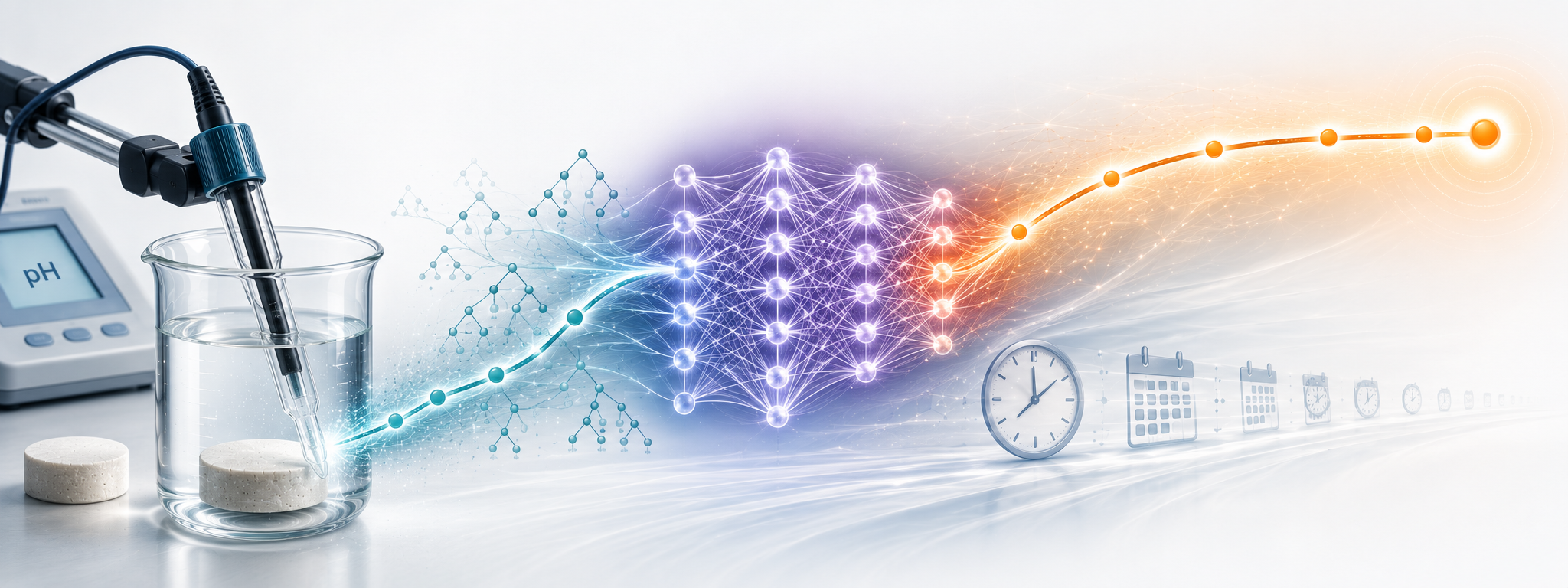
The team built a dataset from in-vitro calcium silicate cement studies in the literature — pH, calcium-ion release, specimen geometry and testing conditions. Rather than feeding the model every variable, they let it find the most informative early predictors; three stood out: pH at 3 h, pH at 24 h and specimen surface area.
Those early signals were used to estimate pH at 72, 168 and 672 h. Crucially, the model was not left on paper: it was validated experimentally against four commercial and three experimental cements, cast at different sizes and measured in the lab — so the forecast was checked against real data, not only the training set.
Those three signals proved far more informative than calcium-ion release alone, which by itself did not reliably track long-term pH — early alkalinity and specimen geometry, not ion release, carried the predictive weight.
pH testing becomes a trajectory that can be forecast early — not a profile that must always be fully measured before decisions are made.
Early readings predicted long-term alkalinity with strong agreement
The model estimated pH at 72, 168 and 672 h with strong predictive performance. Agreement held even at the longest timepoint, although later pH is harder to predict because cement hydration and ion release keep evolving.
In the experimental validation, predicted and measured pH were closely aligned across commercial and experimental cements, and a residual analysis showed no systematic bias — the model was not consistently over- or under-estimating pH.
The practical meaning is direct: early pH data can reveal long-term chemical behavior before the full 28-day window is complete.
A workflow advance for biomaterials development
This is not simply about predicting a number. It shows how material informatics can make biomaterials development more efficient by shortening the time between formulation, testing and refinement.
For calcium silicate cements that matters because formulation changes alter hydration, ion release and alkalinity. A faster readout of long-term pH lets researchers screen more candidates, reduce repetitive testing and focus resources on the most promising materials — AI-assisted research that begins by making lab development faster and more comparable.
Sabino CF, Grymak A, Silikas N, Rosa V. pH prediction in commercial and experimental calcium silicate cements via material informatics. Dental Materials. 2025. doi:10.1016/j.dental.2025.08.018