Designing a bioactive scaffold — without testing everything
Testing every scaffold recipe would take 81 experiments. Taguchi's orthogonal array found the answer in 9 — and showed that composition (4% MTA) is what makes a 3D-printed PCL scaffold bioactive.
Fast facts
- —Optimizing a 3D-printed PCL/MTA scaffold for pulp regeneration with Taguchi's design of experiments.
- —Four inputs at three levels: composition (MTA%), pore size, fibre diameter, number of layers.
- —Five properties measured — pH, degradation, porosity, yield strength, Young's modulus — plus cell tests.
- —Fibre diameter and composition were the most influential inputs; pore size and layers minor.
- —Predictions matched experiments — Taguchi worked as a predictive tool.
- —Only PCL and PCL + 4% MTA allowed cells to grow; 20% MTA was too alkaline.
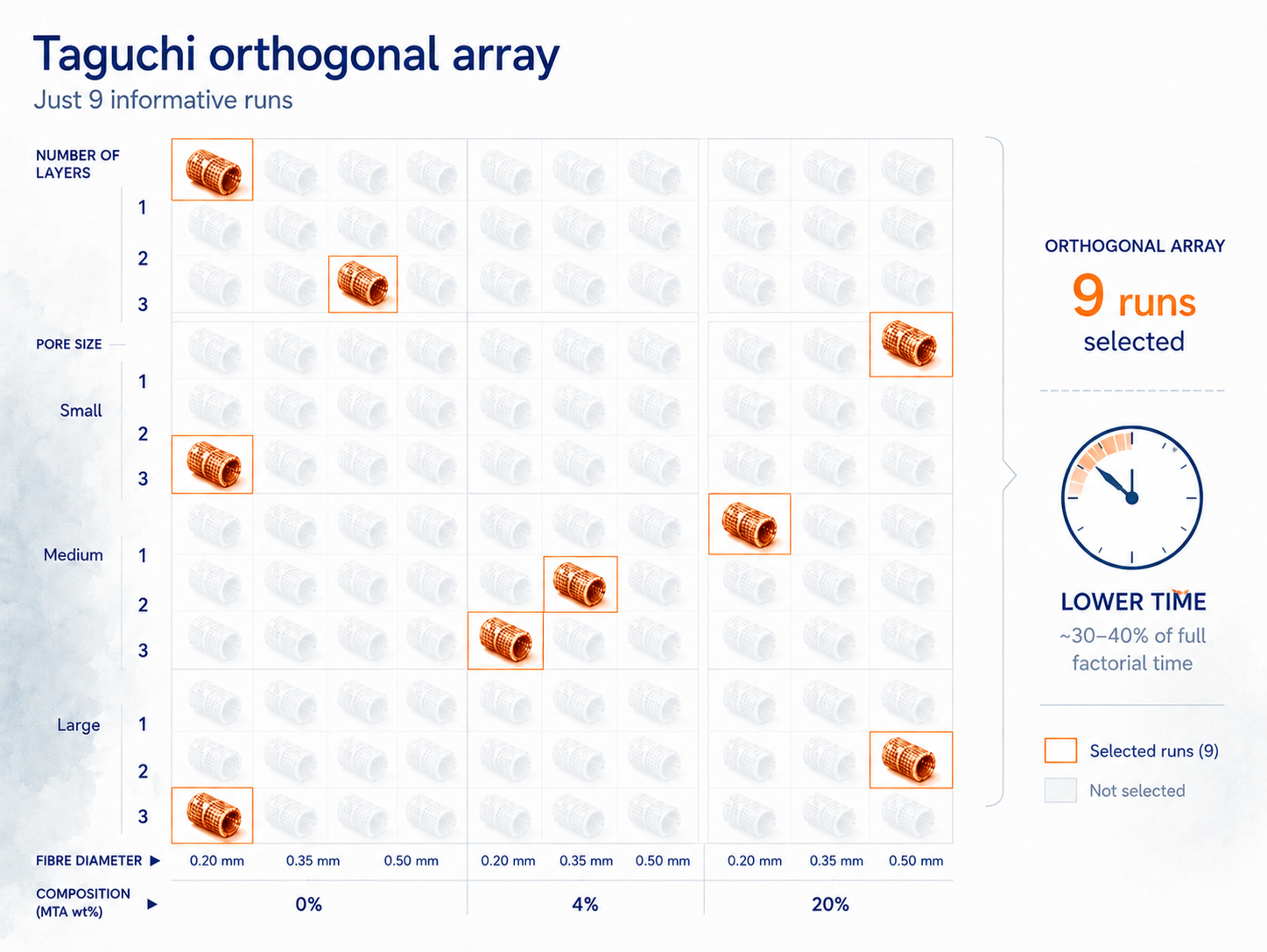
- —An orthogonal array cut 81 experiments to 9 — saving time and cost.
- —It pinpoints which inputs can be ignored when optimizing scaffolds.
- —4% MTA turned an inert polymer into a bioactive, cell-friendly scaffold.
Too many recipes to test
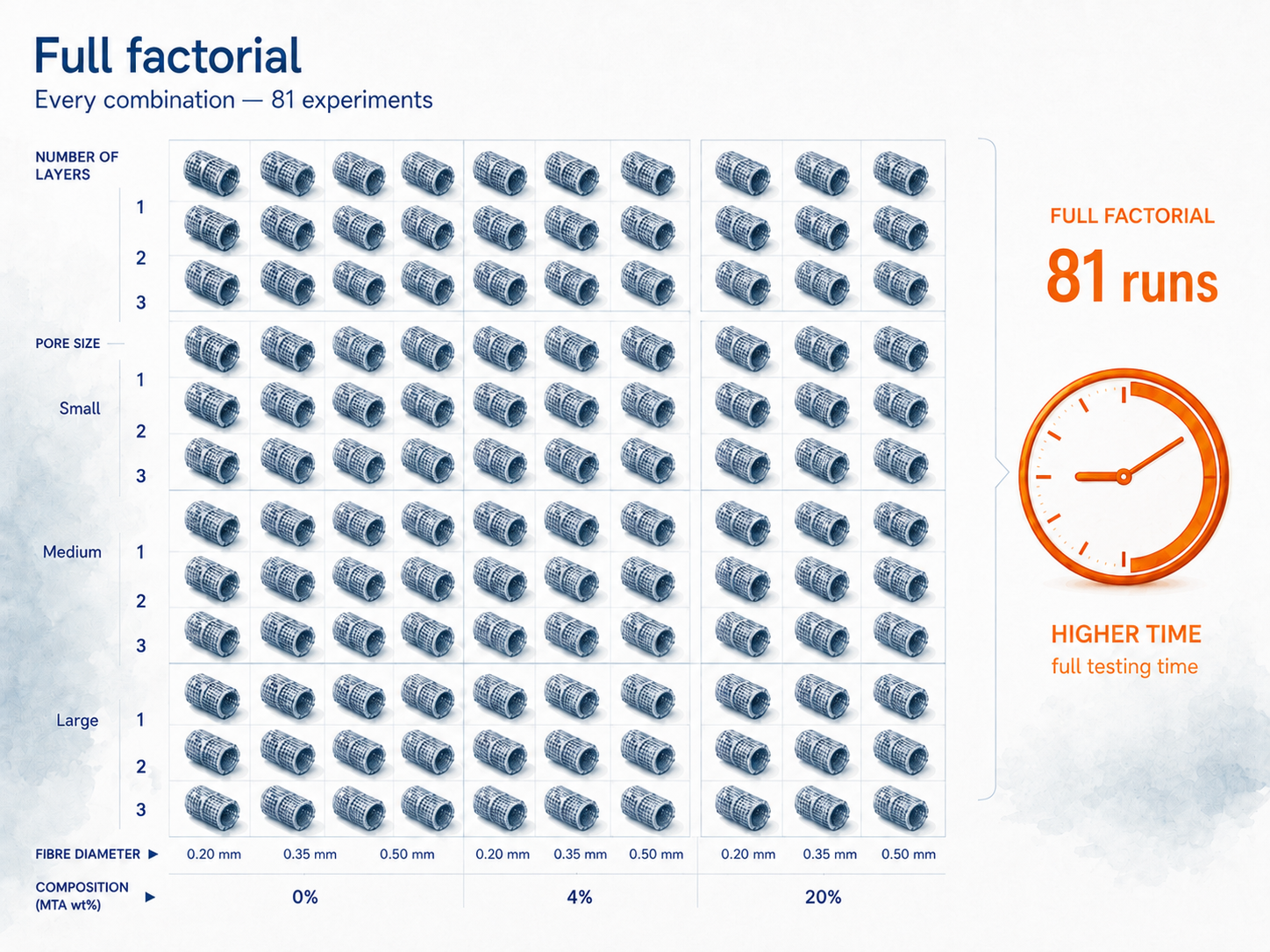
A 3D-printed scaffold has many dials — composition, pore size, fibre diameter, number of layers — and each shifts its pH, degradation, porosity and mechanical strength. Tuning them one at a time, or testing every combination, is slow and expensive.
With four inputs at three levels each, a full factorial study would mean 81 experiments (243 with triplicates). The team needed a way to find what actually matters without running them all.
Taguchi's methods — built on orthogonal arrays — promise exactly that: vary every factor at once, sample each level fairly, and infer which inputs drive the outcome from a small, balanced set of runs.
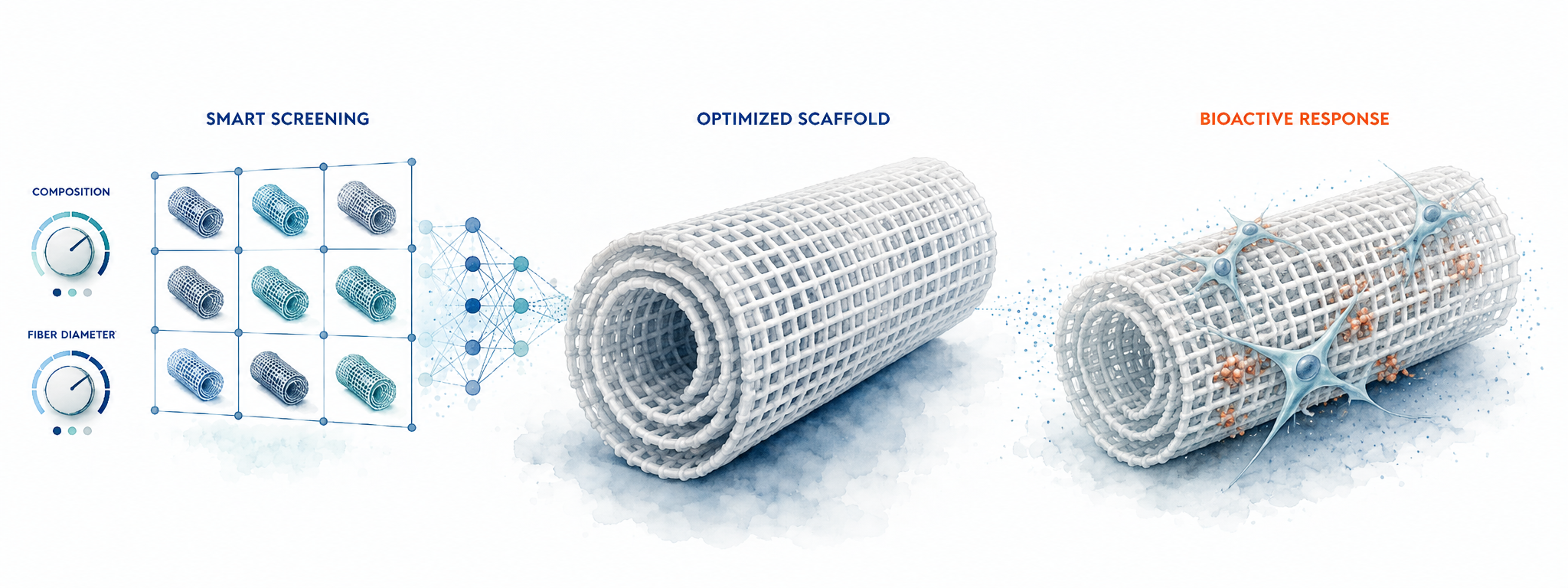
Screen smart, not everything
Instead of all 81 combinations, the team used an L9 orthogonal array — just 9 runs, with each level of each factor appearing the same number of times to avoid bias (Fig. 2 and Fig. 3). Analysis of mean and the signal-to-noise ratio then ranked how strongly each input shaped each property.
The predictions held up: when the designed scaffolds were printed and measured, the experimental pH, degradation, porosity and mechanics matched what the model forecast. Taguchi's method worked as a genuine predictive tool — and, just as usefully, flagged the inputs that can be safely ignored.
Composition drove the biology
Across all five properties, fibre diameter and composition were the most influential inputs; pore size and number of layers mattered far less. Of these, composition was the lever for bioactivity — so it was carried into the biological tests (Fig. 4).
Adding MTA raised the scaffold's pH and degradation. In culture with dental pulp stem cells, only plain PCL and PCL with 4% MTA allowed the cells to grow — 20% MTA made the environment too alkaline. And 4% MTA did more than keep cells alive: it raised the odontogenic genes ALP, COL-1, OCN and MSX-1, turning an inert polymer into a bioactive scaffold.
That ranking held across every property measured — pH, degradation, porosity, yield strength and Young's modulus — so pore size and the number of rolled layers could be set for printability without much penalty, while composition and fibre diameter were the inputs worth tuning. Crucially, the experimental scaffolds behaved as the model predicted, confirming Taguchi's method as a reliable, low-cost guide rather than a rough approximation.
Composition mattered on two fronts at once. The MTA fraction set the scaffold's chemistry — its alkalinity and how fast it broke down — and that same chemistry decided the biological outcome: too little and the polymer stayed inert, too much and the environment turned hostile, with only the intermediate dose supporting cells and driving odonto/osteogenic gene expression.
The lesson: a small, well-chosen dose of bioactive filler — not maximal loading — is what turns an inert printed polymer into a living, mineral-forming scaffold.
A faster route to better scaffolds
The advance is a way of working: let a small, well-designed set of experiments reveal which knobs matter, then tune only those. It turns scaffold optimization from brute-force trial-and-error into a directed, low-cost search.
Here it delivered a printable PCL scaffold made bioactive by 4% MTA — cell-friendly and odontogenic — together with a clear map of which inputs are worth tuning next time.
Bhargav A, Min KS, Wen Feng L, Fuh JYH, Rosa V. Taguchi's methods to optimize the properties and bioactivity of 3D printed polycaprolactone/mineral trioxide aggregate scaffold: theoretical predictions and experimental validation. J Biomed Mater Res B Appl Biomater. 2020;108(3):629–637.